For the second time in a week, the Drupal team has issued a security advisory rated "Highly critical". SA-CORE-2026-017 (CVE-2026-132165), released on 18 November, fixed a problem in install.php, the installer that ships with Drupal core. Under certain conditions an outsider could use it to try to reinstall Drupal over a live site, taking the site over or running code on the server. According to Drupal, attacks on live sites began on 19 November, and CISA added the flaw to its actively exploited list on 24 November.
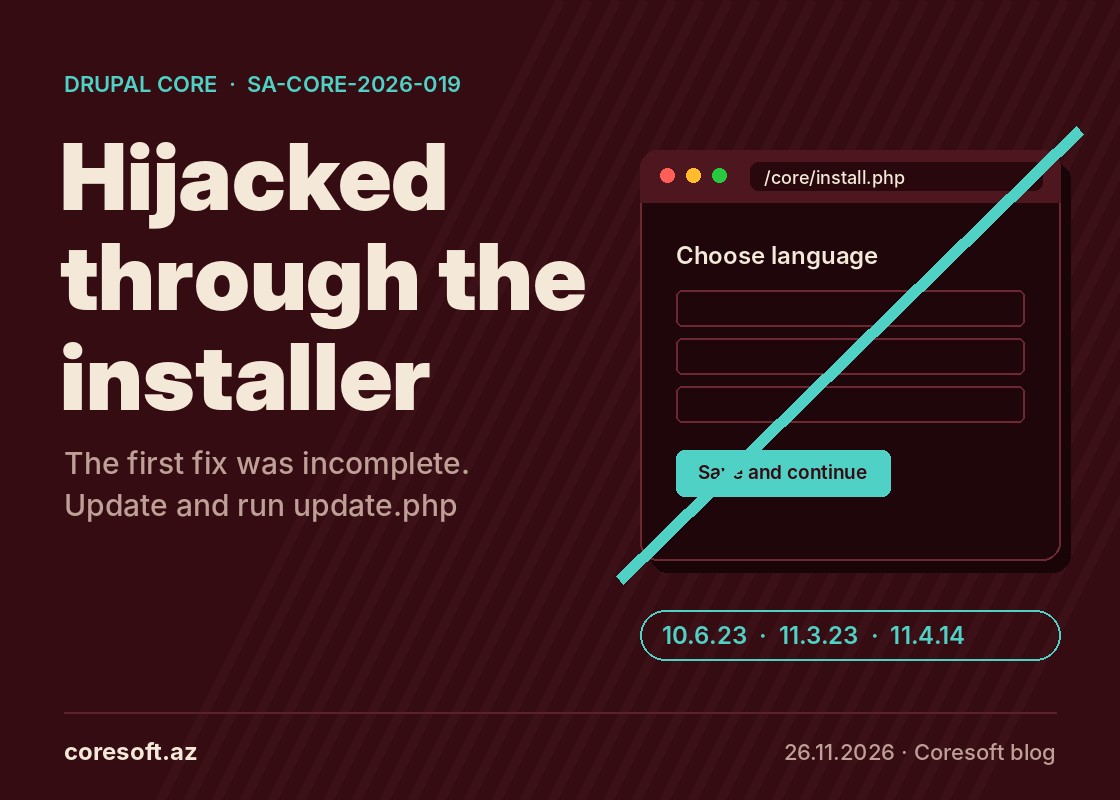
SA-CORE-2026-019 (CVE-2026-136716), published on 25 November, showed that the first fix did not cover every case. Sites left in an incomplete or unusual install state, including production sites, can still be taken over. This state is not visible in the admin UI, and a site that has already been compromised may no longer look vulnerable from the outside.
The fix is in versions 10.6.23, 11.3.23 and 11.4.14. Replacing the files is not enough: update.php or drush updatedb has to be run on every site, and on each site of a multisite setup. The 11.2, 10.5 and older branches are no longer supported and will not get a fix.
Whether or not you have updated, block /core/install.php at the web server level and confirm it from outside. The web server user should not be able to write to settings.php. Review your logs since 18 November for requests to install.php, changes to the user 1 account, new admin accounts and unfamiliar PHP files. Drupal recommends checking that the user 1 email address is one you control and resetting its password. If you find signs of compromise, restoring from a clean backup and changing the database and admin passwords is the safer route.
Sources: Drupal SA-CORE-2026-017, Drupal SA-CORE-2026-019, Beazley Security Labs