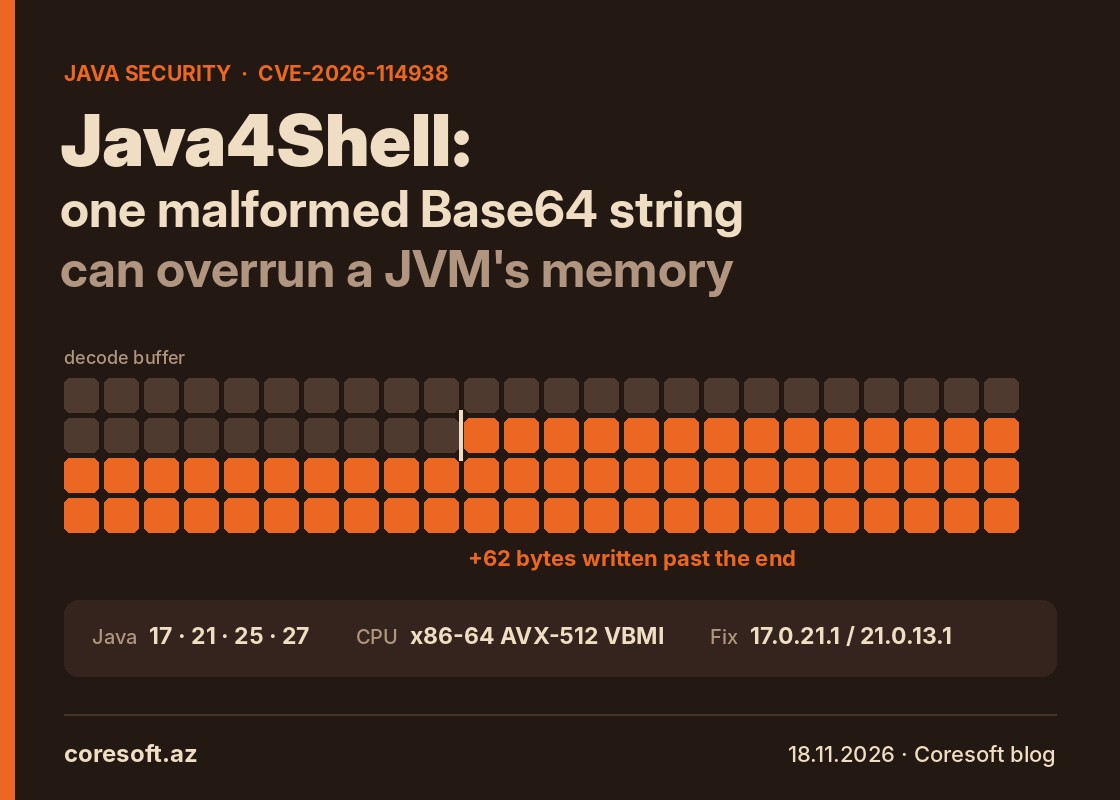
On 17 November Oracle shipped its latest Java security update, and it includes the flaw everyone has been talking about this week: CVE-2026-114938, which the researchers call Java4Shell. It was found by the Calif.io team. The bug sits in the AVX-512 code HotSpot uses to speed up Base64 decoding: a short, deliberately malformed Base64 string makes Java write up to 62 bytes past the end of a buffer before it rejects the input.
Base64 is everywhere: Authorization headers, tokens, file uploads. That means this code often runs before a user has even logged in. The researchers say they achieved code execution on default installs of Keycloak, Jira, Confluence, Jenkins and Artifactory. Some analysts argue a JVM crash is the more realistic outcome. Either way, the service goes down. There are no reports of attacks in the wild so far.
Affected are OpenJDK 17.0.6 and later releases of 17, 21, 25 and 27, but only on x86-64 CPUs with AVX-512 VBMI (Intel Xeon Ice Lake and newer, AMD Zen 4 and newer). ARM servers, Java 8 and Java 11 are not affected. Oracle's fix is in 17.0.21.1, 21.0.13.1 and 25.0.5.1. Amazon Corretto 17 has an update out too, while Temurin, Zulu and Linux packages follow their own schedules.
Check which Java your servers actually run. java -version alone is not enough: applications often bundle their own JDK, and Docker images carry theirs. Until the update is installed, the -XX:-UseBASE64Intrinsics option turns off the fast decoder. It does not replace the fix, and in both cases every Java process has to be restarted.
Sources: Qualys, Equixly, Oracle, The Hacker News