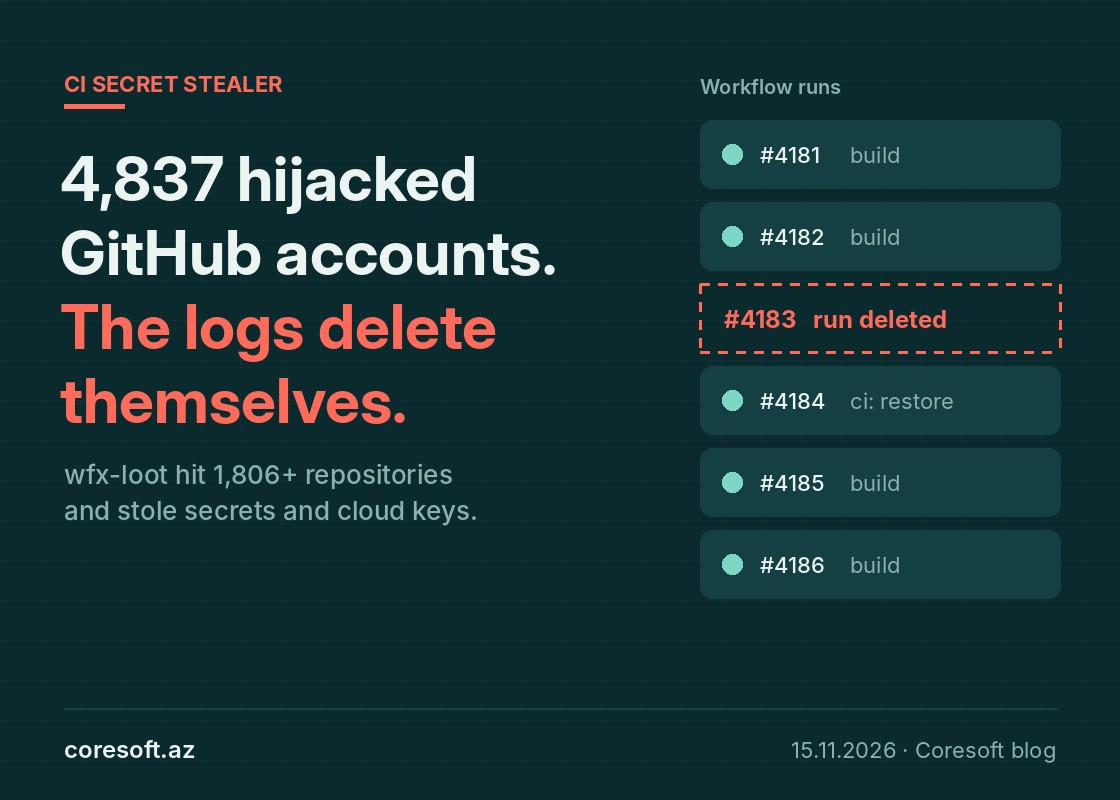
Since 10 November a large attack has been running across GitHub. Aikido Security named it "wfx-loot", after the attacker's own labels. There are no fake packages or name tricks here: the attackers use stolen developer accounts. Through 4,837 accounts they opened probe pull requests in more than 61,000 repositories, and in at least 1,806 of them the malicious script actually ran and collected secrets. Well-known projects such as nextcloud/docker and webdriverio are among the victims.
The playbook is simple. First a harmless-looking PR called docs: dependency audit notes checks for write access. Then a script of roughly 1,500 lines is added to an existing workflow, to a postinstall step in package.json, or to a new workflow on a throwaway branch. It gathers GitHub Actions secrets, AWS, Azure, GCP, SSH, npm and Kubernetes credentials, .env files and even AI service API keys, and ships them to an outside server. Seconds later the change is reverted and the workflow run and its logs are deleted. Often the only trace left is a gap in the run numbers.
The worse part is that the attacker also digs into the cloud: it creates long-lived AWS keys, opens an AWS role's trust policy to any account, and adds federated credentials named wfx-ci- to Azure apps. These keep working after secrets are rotated.
If your team uses GitHub, check the history since 10 November for the commits ci: refresh build cache, chore: add ci helper and ci: restore, a wfx-docs branch, and gaps in workflow run numbers. If you find a trace, rotate every secret your workflows could reach and review CloudTrail and Microsoft Entra logs for new keys and trust policy changes. Going forward, require code owner review for .github/workflows, make GITHUB_TOKEN read-only, and run npm ci --ignore-scripts in CI where you can.
Sources: Help Net Security, Endor Labs.